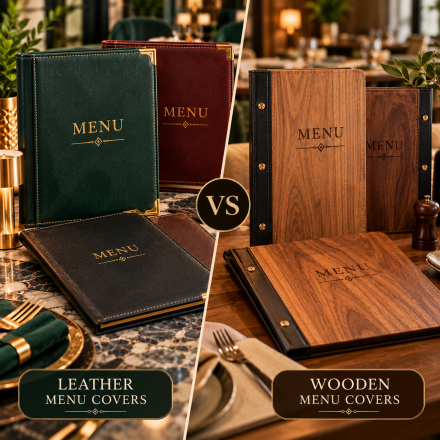
If you’ve started looking into menu covers for your restaurant, café or hotel, you’ve probably run into the same question every property owner runs into eventually: leather or PU? It sounds like a small decision, but it’s one that affects how your menus look after six months of daily handling, how much you’ll spend on replacements, and whether guests actually notice the folder at all — which, done right, they shouldn’t. A menu cover’s job is to disappear into the dining experience while quietly signaling that the property takes itself seriously.
This isn’t a decision with one universal right answer. A 40-cover fine-dining restaurant and a 200-cover café have different priorities, different budgets, and different replacement cycles, and the material that makes sense for one often doesn’t make sense for the other. Below is what actually differs between the two, and how to think about it for your specific setup.
What “Leather” and “PU” Actually Mean for Menu Covers
Before comparing them, it helps to be clear on what each material actually is, since the terminology gets used loosely across suppliers.
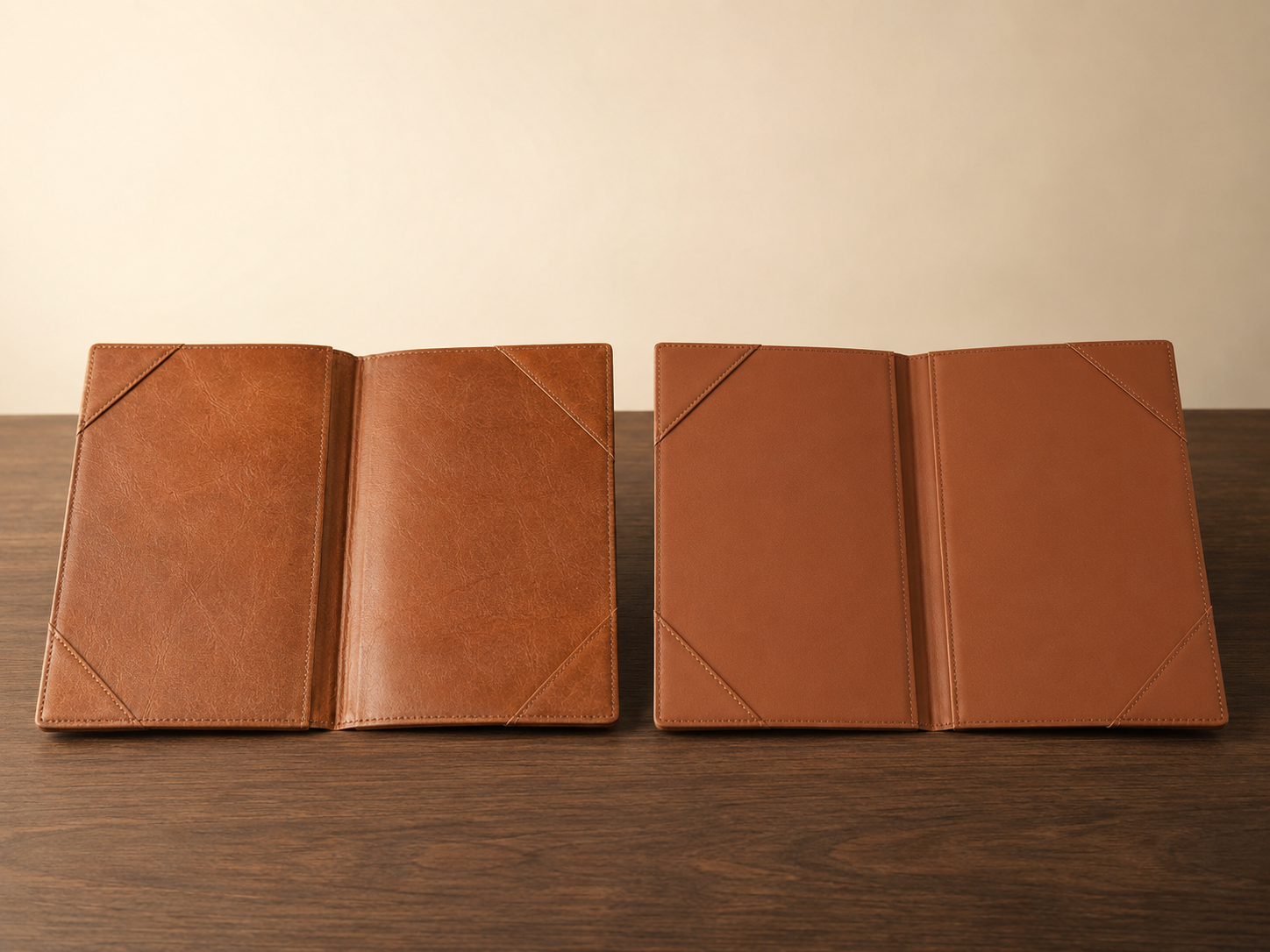
Genuine leather is real hide — usually full-grain or top-grain — tanned and finished for use as a cover material. It has natural grain variation, which means no two covers look perfectly identical, and it develops a slight patina over time with handling.
PU leather (sometimes called PU leatherette, or just “PU”) is a synthetic material — a fabric or paper base coated with polyurethane and embossed with a leather-like grain pattern. It’s manufactured to look consistent across every single unit, which is actually an advantage in some contexts, as we’ll get to.
Neither is inherently “better” — they’re built for different priorities, and the right choice depends on how your covers are going to be used day to day.
Durability — Where the Real Difference Shows Up
This is usually the deciding factor for high-traffic properties, and it’s worth being specific rather than just saying “leather lasts longer,” which is true but incomplete.
Genuine leather resists surface wear well — it doesn’t crack or peel the way a lower-grade synthetic can, and it handles repeated flexing (opening and closing the folder hundreds of times a week) better over a multi-year timeline. It also tends to age in a way that looks intentional — a slight softening and sheen at the edges reads as “well-used premium item” rather than “worn out.”
PU leather’s weak point is the coating layer. Lower-quality PU can start to peel or flake at stress points — usually the spine or corners — after heavy daily use, particularly in humid conditions, since moisture is one of the main things that accelerates coating breakdown. When PU wears out, it tends to look worn out rather than aged gracefully — flaking edges don’t have the same “character” leather picks up.
That said, this gap has narrowed. Better-grade PU with a heavier gauge and reinforced stitching at stress points holds up reasonably well for 12–24 months of daily restaurant use, which is a perfectly reasonable replacement cycle for many properties that update their look periodically anyway.
Rule of thumb: if you’re not planning to redesign or refresh your menu covers for 3+ years, leather’s durability advantage matters more. If you expect to update branding, pricing structure or the covers themselves every 1–2 years anyway, PU’s lower cost usually outweighs the durability gap.
Cost — The Practical Factor Most Owners Actually Decide On
Genuine leather costs meaningfully more per unit than PU — often somewhere in the range of 40–70% more, depending on grade and finish, though exact pricing depends on the specific folder design, size and order quantity. For a small property ordering 15–20 covers, that difference might not be significant in absolute terms. For a hotel group standardizing across 200+ covers over multiple properties, it becomes a real budget line.
This is where a lot of owners land on a hybrid approach without realizing it’s an option: leather for guest-facing, high-visibility use (main dining room menus, VIP or premium menu tiers) and PU for higher-volume, lower-visibility use (bar menus, room-service menus, banquet or event menus that get less individual attention per cover). It’s a reasonable way to control cost without compromising on the covers that guests actually spend time looking at.
Look and Feel — What Guests Actually Notice
Here’s something worth being honest about: most guests cannot reliably tell high-grade PU apart from leather just by looking at a menu cover across a table. What they do notice, even if only subconsciously, is weight, texture under the fingers when they open it, and how the cover sits and lies flat on the table.
Leather has a distinct hand-feel — slightly cooler to the touch initially, with natural texture variation you can feel under your fingers, not just see. PU can be made to closely mimic the visual grain, but the texture underneath tends to feel more uniform, which some guests register as “fine” and others (particularly at higher price points) can pick up on if they’re paying attention.
For most casual and mid-range restaurants, this distinction realistically doesn’t move the needle on the guest experience. For fine dining, boutique hotels, and properties where the physical menu is part of a broader tactile luxury experience (heavy stock paper, weighted cutlery, etc.), it’s more likely to register.
Maintenance — The Part Nobody Asks About Upfront
Genuine leather needs occasional conditioning to stay supple and avoid drying out, particularly in air-conditioned environments that pull moisture out of the material over time. It’s not intensive maintenance, but it is maintenance — most properties handle this as an occasional wipe-down with a leather-appropriate cleaner rather than a scheduled task, but it’s worth knowing it exists.
PU is lower-maintenance in daily use — it wipes clean easily and doesn’t need conditioning — but once the surface coating starts to degrade, there’s no restoring it. Leather can often be lightly reconditioned to extend its life; PU generally can’t.
For a busy front-of-house team without time for material-specific care routines, PU’s low-maintenance profile is a genuine practical advantage, separate from the cost question entirely.
A Simple Way to Decide
If you’re still weighing this, here’s a reasonable way to think it through:
Choose leather if: you’re running a fine-dining or upscale property, you want covers that age well over a 3+ year cycle, the menu cover is genuinely part of your guest’s tactile experience, or you’re ordering a smaller quantity where the per-unit cost difference isn’t a large total.
Choose PU if: you’re running a high-volume café, casual dining, or bar operation, you expect to refresh your menu design within 1–2 years anyway, you’re ordering in large quantities across multiple properties, or low daily maintenance matters more to your team than long-term material aging.
Consider a mix if: you have distinct menu types with different visibility levels (main menu vs. bar/event menu) and want to control cost without compromising the covers guests spend the most time with.
Beyond Material — Other Details That Matter as Much
Material gets most of the attention in this decision, but a few other specifications affect how well a menu cover actually performs at your tables, and are worth deciding alongside material rather than as an afterthought:
Page format — corner-slot, ring-bound, or stitched-page — determines how easily staff can update pricing or seasonal items without replacing the whole cover.
Size — matched to your actual printed menu dimensions rather than a generic standard, so pages don’t shift or gap inside the folder.
Edge and corner finishing — rounded corners and reinforced edges tend to hold up better under daily handling than sharp, unfinished edges, regardless of material.
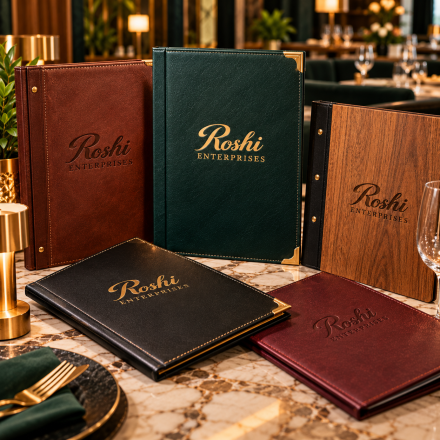
Branding placement — logo embossing reads differently on leather (which takes a deeper, more textured impression) versus PU (which tends to give a cleaner, flatter emboss).
None of these decisions need to happen in isolation from the material choice — a good manufacturer will walk through all of them with you at the same time, since they interact with each other more than most people expect going in.
Frequently Asked Questions
Does leather really last longer than PU for restaurant menu covers?
Generally yes, particularly for daily heavy use over several years. Genuine leather resists surface wear and repeated flexing better than most PU, though higher-grade PU with reinforced stitching can perform reasonably well for a 1–2 year replacement cycle.
Is PU leather noticeably lower quality than real leather?
Not necessarily — better-grade PU holds up well for properties planning to refresh their menu design periodically. The quality gap matters most for properties keeping the same covers for 3+ years without replacement.
Can I mix leather and PU covers across different menu types at the same property?
Yes, this is a common approach — leather for the main dining menu and PU for bar, event or room-service menus, keeping cost down without compromising the highest-visibility covers.
Which material takes logo branding better?
Both take embossing, debossing and foil branding well. Leather tends to give a deeper, more textured emboss; PU gives a cleaner, flatter impression. Neither is objectively better — it depends on the look you want.
How do I decide the right size for our menu covers?
Size should match your actual printed menu dimensions rather than a generic standard size, so pages sit flat without shifting or gapping — this is typically confirmed with your manufacturer before production.