
Currently Empty: ₹0.00

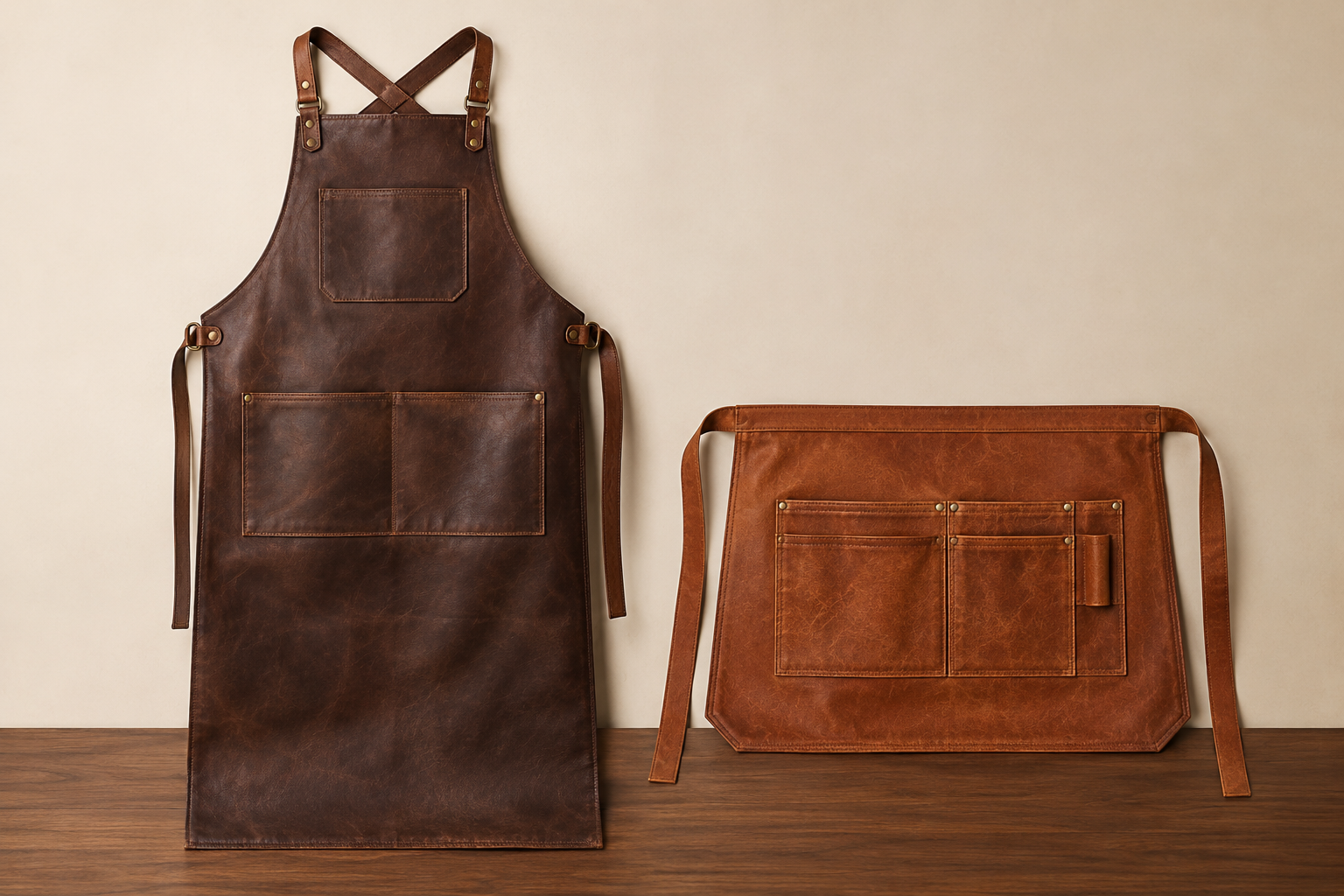
How to Choose a Leather Apron for Kitchen vs Front-of-House Staff
It’s a common mistake when ordering staff aprons for a restaurant or café: treat “apron” as one product, order the same design for everyone, and only notice the problem once the kitchen team is complaining about heat and mobility while front-of-house staff feel like they’re wearing something bulkier than they need for taking orders and running food.
An apron worn by someone standing at a stove for a full shift and an apron worn by someone moving between tables all service need genuinely different things from the garment, even if they’re made from the same material and branded with the same logo. Here’s how to think through the difference before placing a bulk order.
Why One Apron Design Rarely Works for Every Role
The core issue is that “apron” covers a wide range of actual functions — protection from heat and spills, a place to carry small tools or a notepad, a visual part of the uniform, or some combination of all three — and different roles need different combinations. A chef needs protection first and branding second. A barista or server needs branding and functional pockets first, and generally doesn’t need the same heat protection a kitchen apron provides.
Ordering identical aprons across every role usually means over-specifying for some staff and under-specifying for others — a heavy, full-coverage kitchen-style apron on front-of-house staff looks bulky and unnecessary for a job that doesn’t involve standing over a grill, while a lighter front-of-house-style apron on kitchen staff doesn’t hold up well to the heat and spill exposure the role actually involves.
Kitchen Aprons: What the Role Actually Needs
Coverage and Length
Kitchen staff generally need full-length, bib-style coverage — chest to knee — since they’re exposed to splashes, spills and heat across a wider area of the body than front-of-house staff. A waist-only apron doesn’t offer enough protection for someone working directly at a stove or prep station for a full shift.
Material
Leather holds up better than PU in a kitchen environment specifically because of heat and moisture exposure — PU’s weak point is its coating, and repeated heat and spill contact is exactly the kind of stress that degrades a synthetic coating faster than it would in a lower-exposure role. If budget allows for leather anywhere in a mixed apron order, kitchen staff aprons are the place it matters most.
Strap Design
This is the detail that gets overlooked most often, and it’s the one kitchen staff notice fastest. A simple neck-loop strap can dig into the back of the neck over a full shift standing at a station — an adjustable strap, or better, a cross-back design that distributes weight across both shoulders rather than the neck, makes a meaningful difference for staff wearing the apron for hours at a time. This is worth prioritizing over aesthetic considerations for kitchen-specific orders.
Pockets
Kitchen apron pockets are typically simpler — one or two functional pockets for a towel or a small tool, rather than the more detailed multi-pocket layout front-of-house staff often need. Overloading a kitchen apron with pockets doesn’t add much value and can get in the way of movement at a busy station.
Front-of-House and Barista Aprons: What the Role Actually Needs
Coverage and Length
Waist-length is generally the better fit here — front-of-house staff need mobility and a lighter presence more than the full-body protection a kitchen role requires. A waist apron also tends to read better visually for guest-facing staff, since it doesn’t cover as much of a server’s or barista’s uniform underneath.
Material
PU leather often makes more practical sense for front-of-house and barista aprons, particularly for larger teams, since the exposure to heat and heavy spills is lower than in the kitchen and the cost savings scale meaningfully across a bigger front-of-house headcount. That said, some properties do specify leather for front-of-house staff specifically because it reads as more premium to guests — a reasonable choice for upscale or fine-dining settings where the visual impression matters more than the cost difference.
Pockets
This is usually where front-of-house and barista aprons need more thought than kitchen aprons, not less. A server or barista often needs to carry a notepad, a pen, a phone, or small tools throughout a shift, so a multi-pocket layout — sometimes with a dedicated pen loop — tends to matter more here than heavy-duty protection.
Branding Visibility
Since front-of-house and barista staff are the ones guests actually see and interact with, branding placement and visibility often matters more on this apron than on a kitchen apron, which stays behind the scenes. A clearly placed, well-embossed logo on a front-of-house apron does more brand-visibility work per unit than the same logo on a kitchen apron nobody but the staff sees.
A Simple Comparison
| Detail | Kitchen | Front-of-House / Barista |
|---|---|---|
| Coverage | Full-length bib | Waist-length |
| Priority | Heat/spill protection | Mobility, branding visibility |
| Material | Leather (where budget allows) | PU leather (or leather for upscale settings) |
| Strap | Adjustable / cross-back | Simple neck-loop or adjustable |
| Pockets | Minimal, functional | Multi-pocket, often with pen loop |
Ordering Both Together: Keeping the Uniform Consistent
None of this means kitchen and front-of-house aprons need to look unrelated — most properties order both with a consistent colour and the same branding approach, just with different cuts and configurations underneath. This keeps the overall staff uniform feeling coordinated while still giving each role what it actually needs functionally. Since minimum order quantity applies per product configuration, ordering, say, 15 kitchen-style aprons and 15 front-of-house-style aprons in the same batch typically still needs each to independently reach the standard minimum — worth planning for if you’re ordering across multiple roles at once.
The Bottom Line
Kitchen and front-of-house aprons solve different problems, even under the same brand and the same logo. Kitchen staff need protection and durability first; front-of-house and barista staff need mobility, pocket function, and visible branding first. Specifying these separately rather than ordering one uniform design across the whole team tends to produce aprons staff actually want to wear for a full shift, rather than ones they tolerate.
Frequently Asked Questions
Should kitchen and front-of-house staff wear the same apron?
Not ideally. Kitchen roles need full-length coverage and heat/spill-resistant material; front-of-house and barista roles typically need lighter, waist-length aprons with more functional pockets. Both can share consistent colour and branding while differing in cut.
Is leather or PU better for a kitchen apron?
Leather generally holds up better in a kitchen environment due to heat and moisture exposure, which tends to wear down PU’s coating faster than in lower-exposure roles.
What strap style works best for staff on their feet all shift?
An adjustable strap or cross-back design distributes weight across both shoulders rather than the neck, which matters more for kitchen staff working a full shift at a station.
How many pockets should a barista or server apron have?
Enough for a notepad, pen and phone if the role requires carrying them — often a multi-pocket layout with a dedicated pen loop, which matters more here than on a kitchen apron.
Can we order different apron styles for different roles in one batch?
Yes, though each distinct configuration typically needs to independently meet the standard minimum order quantity, since different cuts require separate setup.
What’s the minimum order quantity for leather aprons?
25 pieces per configuration


