Corporate gifting season in India runs on a fairly predictable clock — Diwali in the autumn, followed by a second wave around year-end and New Year. If you’re the person responsible for sourcing gifts for clients, employees, or both, you’ve probably noticed the same problem shows up every cycle: the good gifting vendors get booked up early, and starting the process late usually means settling for whatever’s already in stock rather than something that actually represents the company well.
This is less a “gift ideas” list in the generic sense and more a practical guide to how corporate leather gifting actually works — what to consider, how to think about budget tiers, and what timeline you’re realistically working with if you’re starting now.
Why Leather Gift Sets Work for Corporate Gifting
Leather goods occupy a useful middle ground in corporate gifting. They read as considered and reasonably premium without tipping into the kind of extravagant gift that makes a corporate relationship feel uncomfortable rather than appreciated. They’re also practical — a coaster set, a gift box, or a leather accessory gets used rather than sitting in a drawer, which matters if the goal is the recipient actually remembering who sent it.
The other advantage, specific to ordering from a manufacturer rather than buying retail, is that leather goods take branding well. A company logo embossed or debossed onto a gift box lid or a coaster reads as intentional rather than like a sticker slapped onto a generic product — which matters more than people initially expect when the whole point of the gift is brand recall.
Client Gifts vs. Employee Gifts: Different Goals, Different Choices
It’s worth separating these two categories early, since they usually need different budgets and different products, even though both fall under “corporate gifting.”
Client and Partner Gifting
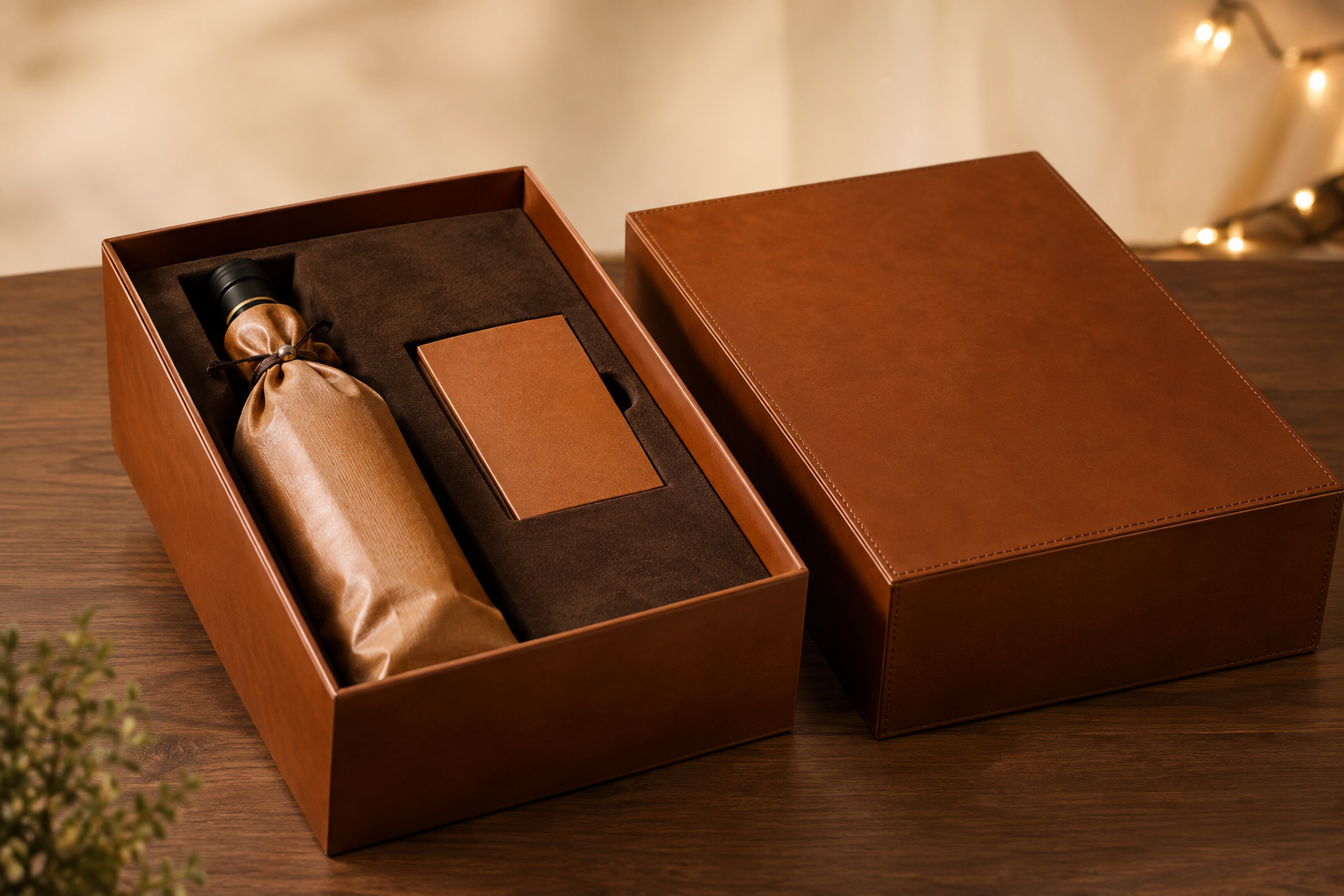
This is usually the smaller-quantity, higher-per-unit-budget category — a leadership team gifting 20–50 key accounts or partners rather than a full company roster. Leather is often the better material choice here over PU, since the quantity is small enough that the material cost difference doesn’t scale into a large total, and the recipient is more likely to register material quality. A well-built leather gift box, sized around whatever’s inside it — a bottle, a hamper, a curated set — tends to land better than a generic pre-boxed hamper with a logo sticker on top.
Employee Gifting
This is typically the higher-quantity, more budget-conscious category, since it scales with headcount rather than account count. PU leather often makes more practical sense here, particularly for larger companies, since the per-unit savings compound significantly at scale without necessarily compromising how the gift is received — most employees aren’t evaluating material grade the way a client relationship manager might. A coaster set or a smaller leather accessory, rather than a full gift box, is a common way to keep per-unit cost reasonable while still giving something people will actually use at their desk or at home.
Building a Gift Set: What Goes Inside Matters as Much as the Box
One detail that gets overlooked until late in the process: a gift box’s interior needs to be built around what’s actually going inside it, not treated as a generic container you figure out after everything else is decided. If you’re gifting a bottle, a card, and a small accessory together, the box’s interior compartments need to be sized for that specific combination — a loose-fitting generic insert undermines the whole effort, since it’s the difference between a gift that feels put-together and one that feels like items were dropped into a box.
This means deciding what’s actually inside the gift — even roughly — needs to happen before finalizing the box, not after. If you’re still deciding between a bottle-based gift and a stationery-based gift, it’s worth settling that first, since it changes the box’s internal structure meaningfully.
A Rough Way to Think About Budget Tiers
Without attaching specific numbers (since pricing depends on quantity, material and box format), here’s a reasonable way to think about tiering a gifting program if you’re gifting different groups at different levels:
Leadership / key client tier — smaller quantity, leather exterior, fully custom interior built around a specific curated item set, individual branding attention.
Mid-tier clients or senior staff — moderate quantity, leather or higher-grade PU, semi-custom interior (a standard compartment layout that still fits the general gift type), consistent branding across the batch.
Broad employee or bulk tier — larger quantity, PU leather, simpler standard interior layout, same branding applied consistently across the full batch for a uniform look when gifts are distributed together.
This isn’t a rigid framework — it’s a starting point for a conversation with whoever’s approving the gifting budget, since it’s usually easier to get sign-off on three clear tiers than one undifferentiated ask.
Timeline: When to Start
This is the part people most often get wrong. Corporate gifting has a hard deadline — a festival date, a year-end cutoff — and manufacturing doesn’t compress well under pressure the way a retail purchase does.
For a standard bulk order (25+ pieces, our minimum order quantity), production typically takes 3–7 days once material, size, colour and branding are all confirmed. But that 3–7 day window doesn’t include the decisions that come before it — settling on gift contents, confirming box format and interior layout, finalizing a logo file, and potentially ordering and reviewing a sample first, which is worth doing given a paid sample is a small cost relative to catching a fit or branding issue before a full batch runs.
A realistic planning window, working backwards from a festival or year-end date, looks something like: decide on gift contents and budget tier → confirm specification and order a sample → review sample and confirm → place the bulk order → allow the 3–7 day production window → account for shipping time to reach recipients, especially if gifts are going to multiple offices or client locations.
Starting this process with only a week or two of total runway before the target date leaves very little room for the sample-review step, which is the stage most likely to catch a problem worth catching before it’s produced 50 or 100 times over.
Keeping Branding Consistent Across a Mixed Order
If your gifting program includes more than one product — say, gift boxes for clients and a smaller coaster set for employees — material and branding can generally be kept visually consistent across both, even though each product is manufactured as its own batch and still needs to independently meet the minimum order quantity. This matters more than people expect for how a gifting program reads as a whole: a client gift box and an employee coaster set that clearly come from the same visual family look like a coordinated program rather than two unrelated purchases.
The Bottom Line
Leather corporate gifting works well because it’s practical, brand-friendly, and scales sensibly across different budget tiers for different audiences. The two things most worth getting right are deciding what’s actually going inside the gift before finalizing the box, and starting the process early enough to allow for a sample review — since festival and year-end deadlines don’t leave room to compress production once you’re already close to the date.
Frequently Asked Questions
Should client gifts and employee gifts use the same material?
Not necessarily. Leather is often worth the cost for smaller-quantity client or leadership gifting; PU leather is a practical choice for larger-scale employee gifting where per-unit cost matters more.
How far in advance should we start planning Diwali or year-end gifting?
Enough time for deciding gift contents, confirming specification, ordering and reviewing a sample, placing the bulk order, allowing 3–7 days for production, and accounting for shipping — starting with only a week or two of total runway leaves little room for the sample step.
Can the gift box interior be built around what we’re actually gifting?
Yes, interior compartments are built around the specific items being packed — a bottle, a card, a small accessory — rather than sold as a single generic insert.
Can we run a tiered gifting program with different products for different groups?
Yes, and material and branding can generally be kept visually consistent across different products in the same program, even though each is manufactured as a separate batch.
What’s the minimum order quantity for gift boxes?
25 pieces, our standard minimum across products.
Is there time to order a sample if we’re on a tight deadline?
It depends on how much runway remains — a paid sample is worth the time if possible, since it’s a much smaller risk than discovering a fit or branding issue after the full batch is produced. Worth discussing your specific timeline directly.