Choosing a menu cover may seem like a small decision when opening or renovating a restaurant, but it is one of the few branded items almost every guest physically handles.
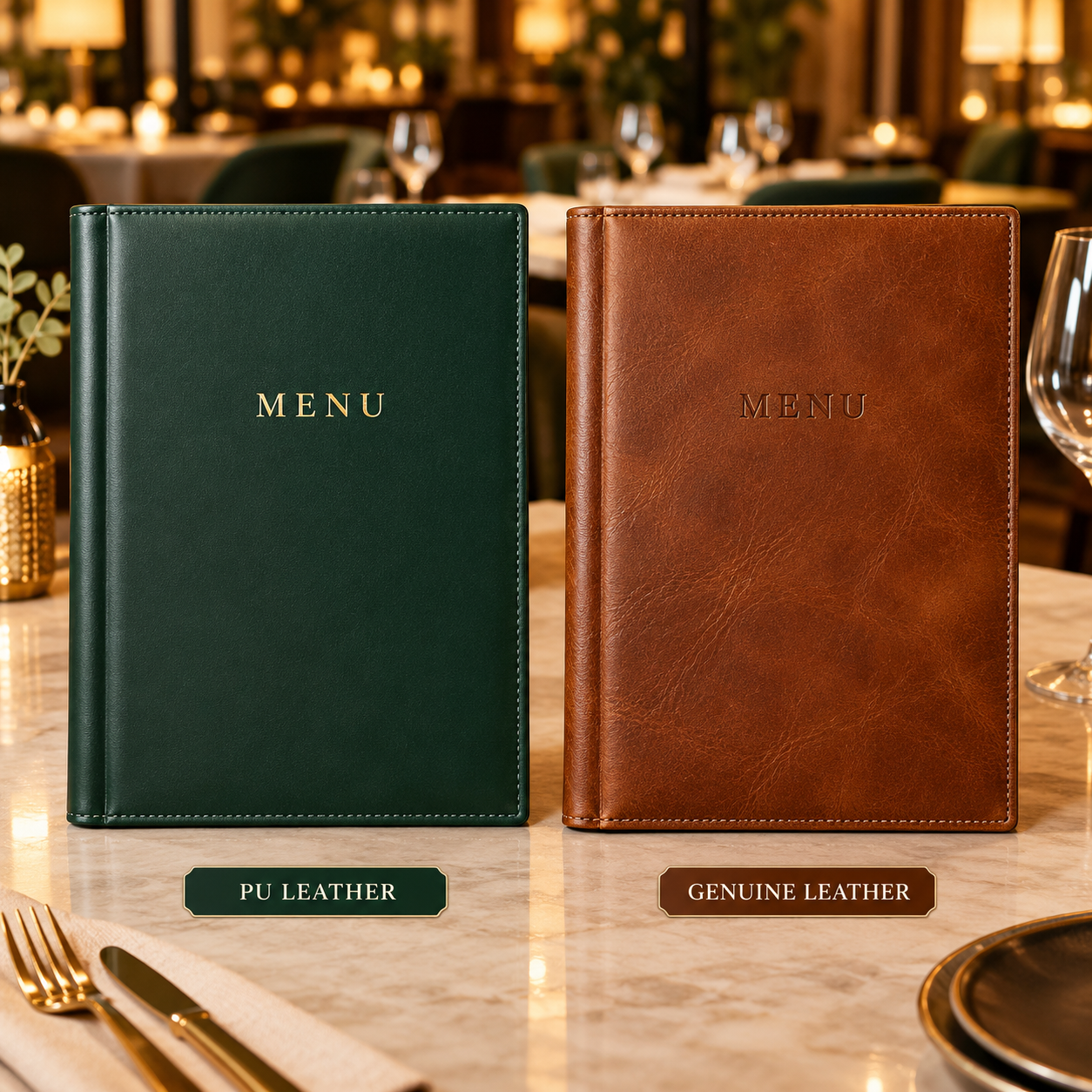
For restaurants, cafés and hotels considering custom menu folders, two commonly considered materials are PU leather and genuine leather.
Both can create a professional presentation, but they differ in appearance, feel, maintenance, cost and suitability for different hospitality environments.
So, should your restaurant choose PU leather or genuine leather menu covers?
Let’s compare them.
What Is a PU Leather Menu Cover?
PU, or polyurethane leather, is a synthetic material designed to provide a leather-like appearance without using genuine leather.
For hospitality businesses, PU leather menu covers can provide considerable flexibility in colours, textures and finishes.
They are particularly worth considering when a restaurant needs a larger quantity of coordinated menu folders while maintaining a consistent appearance across the entire order.
PU leather can be used for more than food menus as well. Restaurants may coordinate menu folders with bill presenters, beverage menus and other table accessories.
What Is a Genuine Leather Menu Cover?
Genuine leather is made using natural animal hide.
Because it is a natural material, its grain, texture and appearance can vary. This variation is often part of the appeal for restaurants and hotels seeking a traditional or premium presentation.
A genuine leather menu folder can work particularly well in environments such as fine-dining restaurants, luxury hotels, premium bars and hospitality venues where tactile presentation is an important part of the brand experience.
PU Leather vs Genuine Leather Menu Covers
The right choice depends on your restaurant rather than one material being universally better.
1. Appearance
Both materials can provide an attractive premium appearance.
PU leather generally offers a more uniform surface and can be produced in a wide variety of colours and textures.
Genuine leather has natural variations that can give individual covers a more distinctive character.
A contemporary restaurant seeking highly consistent covers may therefore have different priorities from a heritage hotel or steakhouse looking for a natural leather appearance.
2. Cost
Budget can become especially important when ordering menu folders in bulk.
PU leather is generally positioned as a more economical alternative to genuine leather, although the final cost of a menu folder also depends on its construction, dimensions, binding system, quantity and customization.
For a restaurant requiring dozens or hundreds of menu folders, even a relatively small difference in unit cost can significantly affect the total order.
Instead of comparing material price alone, calculate the cost based on your required quantity and specifications.
3. Maintenance
Restaurant menus are handled frequently and can encounter fingerprints, food and drink during normal service.
This makes maintenance an important consideration.
PU surfaces can offer straightforward everyday care, depending on the specific material and finish.
Genuine leather may require more careful maintenance to preserve its appearance over time.
Before placing a bulk order, ask the manufacturer for cleaning and maintenance recommendations for the exact material being considered.
4. Feel and Guest Experience
This is an area where physical samples can be particularly useful.
Guests don’t just look at menus—they hold them.
Weight, texture, flexibility, stitching and the way the folder opens all contribute to the experience.
Genuine leather can provide the natural tactile characteristics associated with leather goods, while high-quality PU can provide a clean and consistent presentation suitable for many restaurant concepts.
Neither should be evaluated from website photographs alone when you’re considering a substantial custom order.
5. Branding and Customization
A restaurant menu folder becomes significantly more useful as a branding element when it incorporates the restaurant’s visual identity.
Depending on the material and construction, customization options can include:
- Logo embossing or debossing
- Foil stamping
- Printed branding
- Custom colours
- Contrast stitching
- Metal details
- Custom dimensions
- Different binding mechanisms
The logo should complement the folder rather than overwhelm it.
For example, a subtle debossed logo may work for a minimalist fine-dining restaurant, while another venue may prefer a more visible metallic finish.
You can browse custom menu folders from Roshi Enterprises to see different styles suitable for hospitality applications.
6. Consistency Across Large Orders
This matters particularly for hotels, restaurant groups and chains.
Synthetic materials such as PU can generally provide a highly consistent appearance across multiple pieces.
Natural leather inherently has some variation in grain and texture.
Whether that variation is desirable depends on the brand.
A boutique restaurant may appreciate the individual character of natural leather, while a multi-location restaurant chain may prioritize uniformity.
When Should a Restaurant Consider PU Leather?
PU leather can be worth considering when you want:
A professional leather-style appearance without necessarily using genuine leather.
Consistency across multiple menu folders, particularly for larger orders.
A wider selection of colours and finishes to coordinate with restaurant branding.
Practical everyday usage in a busy hospitality environment.
It can therefore work well for cafés, casual-premium restaurants, hotels, bars and restaurant groups.
When Should a Restaurant Consider Genuine Leather?
Genuine leather may be appropriate when:
Natural material is part of the desired presentation.
The restaurant is positioned toward premium or luxury dining.
Texture and tactile experience are important to the brand.
Natural variation between individual pieces is acceptable or desirable.
Fine-dining restaurants, luxury hotels, private clubs and premium hospitality venues may therefore consider genuine leather.
Don’t Choose the Material Before Considering the Restaurant
A common mistake is deciding:
“Leather is more expensive, therefore it must be better.”
That’s not necessarily how restaurant purchasing should work.
Consider the environment first.
A high-volume restaurant with hundreds of guests per day may prioritize maintenance and consistency.
A small luxury restaurant may prioritize tactile presentation.
A hotel may need coordinated menu folders across restaurants, bars, room service and other outlets.
The best material is therefore the one that suits the brand, usage, budget and operational requirements.
Consider the Binding System Too
Material isn’t the only decision.
Think about how the printed menu pages will sit inside the cover.
If your restaurant frequently changes dishes or prices, a replaceable-page system can make updates easier.
If the menu rarely changes, a different construction may be appropriate.
Before ordering, establish:
- Menu dimensions
- Number of pages
- Frequency of menu changes
- Portrait or landscape orientation
- Binding preference
- Required quantity
Our previous guide explains these considerations in more detail: How to Choose the Right Custom Menu Folder for Your Restaurant.
Important: if yesterday’s article ended up with a different URL, replace that link with the actual published URL.
Ask for Samples Before Placing a Large Order
Material descriptions and photographs are helpful, but physical samples provide much more information.
A sample lets you evaluate:
Texture • Colour • Thickness • Stitching • Logo finish • Binding • Overall construction
If you’re ordering menu folders for an entire restaurant or hotel, confirming these details before full production can prevent costly misunderstandings.
Custom Restaurant Menu Folders from Roshi Enterprises
Roshi Enterprises manufactures customized products for hospitality businesses, including restaurant menu folders in different materials, styles and configurations.
Restaurants, hotels and cafés can discuss their required size, quantity, branding and material preferences before placing a bulk order.
Explore the Menu Folder collection or contact Roshi Enterprises to discuss your customization requirements.
Ultimately, the choice between PU leather and genuine leather menu covers shouldn’t come down to which material sounds more premium.
Choose according to how the menus will actually be used, how they fit your restaurant’s identity and what type of experience you want to create for your guests.
Frequently Asked Questions
Is PU leather suitable for restaurant menu covers?
PU leather can be suitable for restaurant menu folders because it provides a leather-style appearance and is available in numerous colours, textures and finishes. Suitability ultimately depends on the particular material quality and construction.
Is genuine leather better than PU for menu folders?
Not automatically. Genuine leather offers natural characteristics and variation, whereas PU can provide greater uniformity and may suit different budgets and operating environments. The better choice depends on the restaurant’s requirements.
Can a restaurant logo be added to leather menu covers?
Yes. Depending on the material and design, customization can include techniques such as embossing, debossing, foil application or printing.
Should restaurants order a sample first?
For larger customized orders, evaluating a physical sample can be useful because it allows the buyer to inspect material, colour, logo treatment and construction before production.
Where can restaurants order custom menu folders in India?
Roshi Enterprises supplies customized menu folders for hospitality businesses. Buyers can explore the menu folder range and enquire about bulk customization.




[…] If you’re leaning toward leather but aren’t sure whether to choose genuine leather or PU, read Roshi’s PU Leather vs Genuine Leather Menu Covers comparison. […]
[…] menu materials, Roshi’s PU leather vs genuine leather menu cover guide can help when selecting the broader tabletop material palette. […]