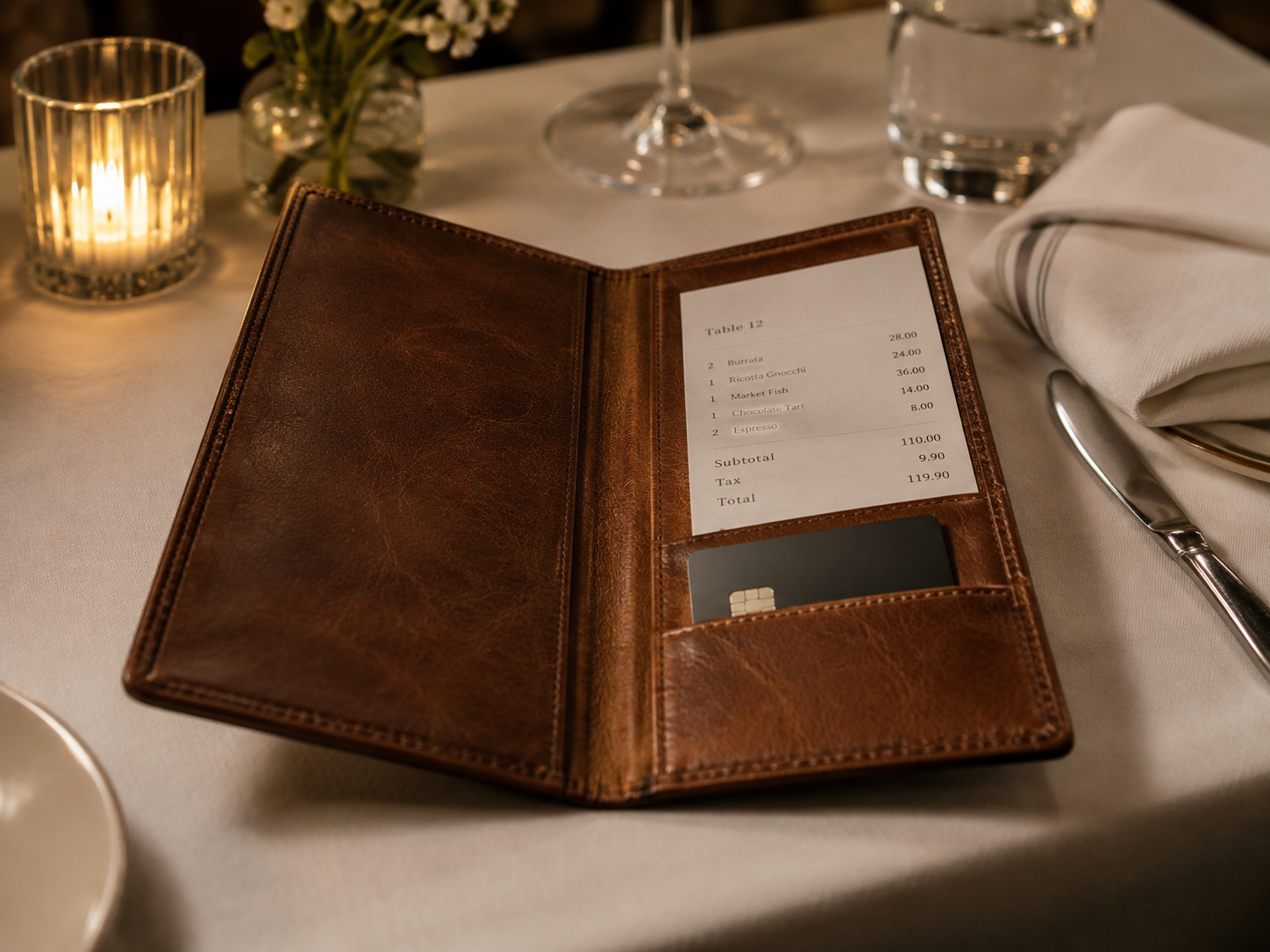
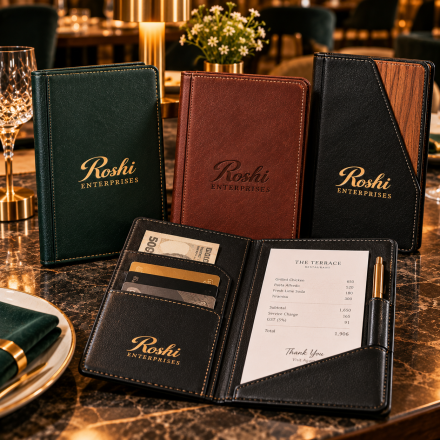
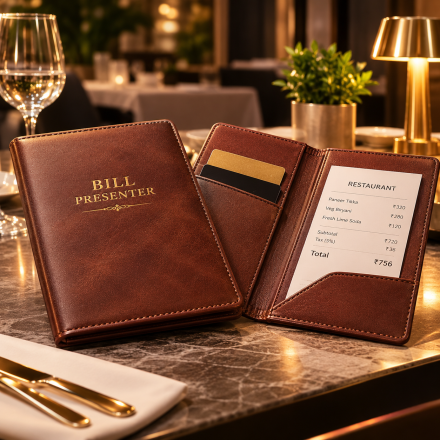
If you’ve searched for this product online, you’ve probably noticed the terminology isn’t consistent. Some suppliers call it a bill presenter. Others say bill folder. A few, particularly ones writing for export or US-facing audiences, use check presenter. If you’re trying to order the same thing everyone else seems to be calling something different, it’s reasonable to wonder whether these are actually different products — or just different names for the same one.
Short answer: mostly the same product, with some regional and contextual differences worth knowing before you order. Here’s what’s actually going on.
Why the Terminology Is Inconsistent
The product itself — a folder that holds a guest’s printed bill or invoice, presented at the end of a meal or stay — is functionally identical across all three names in the vast majority of cases. The naming difference comes down to regional usage and industry convention rather than a meaningful product distinction.
“Bill presenter” and “bill folder” are the terms most commonly used across the Indian hospitality and B2B market. If you’re a restaurant or hotel in India searching for this product, these are the terms you’ll see most on supplier sites and the terms worth using in your own enquiries.
“Check presenter” is used more in US and export-facing contexts, where “check” (rather than “bill”) is the standard word for a restaurant tab. If you’re a US-based buyer, or an Indian manufacturer’s product page is written for an export audience, this is the term you’re more likely to encounter.
None of this reflects a difference in construction, material, or function — it’s the same category of product, described differently depending on which market’s terminology the writer defaults to.
Where a Real Distinction Sometimes Exists
While the terms are largely interchangeable, there are a couple of contexts where you’ll see a genuine (if minor) distinction drawn, and it’s worth knowing about so you’re not confused if a supplier makes this distinction to you.
Bill Book vs. Bill Presenter
Some suppliers — including, historically, some category listings on our own site — use “bill book” to describe the product, which can create a slightly different mental picture than “bill presenter.” A “book” implies something with printed pages or a receipt pad built in; a “presenter” more accurately describes a folder designed to hold a separately printed or handwritten bill without any pages of its own. If a supplier’s site uses “bill book,” it’s worth confirming whether they mean a folder (what most buyers are actually looking for) or a product that includes an actual receipt pad, since these solve different problems.
Formality and Setting
In practice, “check presenter” sometimes correlates (loosely, not strictly) with more formal, fine-dining, or Western-style settings in how the term gets used in marketing copy, while “bill presenter” and “bill folder” show up more evenly across both casual and upscale Indian hospitality contexts. This isn’t a hard rule — it’s more a pattern in how the words tend to get used in copywriting than a structural difference in the product itself.
What Actually Varies Between Bill Presenters (Regardless of What You Call Them)
Since the name doesn’t tell you much about the actual product, here’s what does vary — and what’s worth asking about regardless of which term you or your supplier use.
Internal Configuration
This is the biggest practical difference between one bill presenter and another. A single card slot suits a property settling mostly by card. A card-plus-cash pocket suits a property handling a mix of payment methods. A simple flat-fold with no internal pocket suits a property that just needs something to hold a printed bill without any payment-holding function at all. This matters far more to how the product performs at your tables than what it’s called.
Material
Leather or PU leather, generally matching the same material logic as menu folders — leather for a more premium, longer-lasting option; PU for lower cost across a larger order. Since a bill presenter typically needs to match or complement a property’s existing menu folders, material consistency across both products is usually worth asking about together.
Size
Sized to standard billing slip dimensions in most cases, though this is worth confirming against your actual invoice or receipt printer output rather than assuming a generic size will fit — a presenter that’s slightly too small for your printed bill is a common (and avoidable) fit issue.
Branding
Most bill presenters take a smaller branding mark than a menu folder, simply because the surface area is smaller. Embossing, debossing and foil stamping are all standard options regardless of what the product is called.
Which Term Should You Use When You Enquire?
Practically speaking, use whichever term feels natural to you — any manufacturer serving the Indian hospitality market should recognize all three terms and understand you’re describing the same category of product. If you want to be extra clear in a first enquiry, it doesn’t hurt to briefly describe the function rather than relying on the term alone: “a folder to present the bill at the table, with a slot for the card or change” removes any ambiguity regardless of which word you reach for.
If a supplier’s site specifically uses “bill book” and you’re not sure whether they mean a folder or something with printed pages included, it’s worth clarifying directly before assuming either way.
The Bottom Line
Bill presenter, bill folder and check presenter are, in the overwhelming majority of cases, three names for the same product — the naming difference reflects regional and market convention, not a structural or functional distinction. The details that actually matter when choosing one — internal configuration, material, sizing against your actual billing format, and branding — are the same questions worth asking regardless of which term you or your supplier prefer to use.
Frequently Asked Questions
Is a check presenter the same as a bill presenter?
Yes, in almost all cases. “Check presenter” is more common in US and export-facing contexts; “bill presenter” and “bill folder” are the standard terms in the Indian hospitality market. The product itself is generally the same.
What’s the difference between a bill book and a bill presenter?
“Bill book” sometimes implies a product with printed pages or a receipt pad included, while a bill presenter is a folder designed to hold a separately printed or handwritten bill. Worth confirming directly with a supplier if their listing uses “bill book,” since the two solve different needs.
What internal configuration should I choose for my restaurant?
It depends on how you settle bills — a single card slot suits card-heavy properties, a card-plus-cash pocket suits mixed payment methods, and a flat-fold with no pocket suits properties that just need to hold a printed bill.
Should my bill presenter match my menu folders?
Many properties do match material and colour across both, since they’re often handled by the same guest in the same visit. It’s a reasonable thing to standardize if you’re ordering both from the same manufacturer.
Does it matter what I call it when I enquire with a supplier?
Not really — any manufacturer serving this market should recognize bill presenter, bill folder, and check presenter as the same category. Describing the function (a folder to hold the bill, with or without a card/cash slot) removes any ambiguity if you’re unsure which term to use.